
Grades measure what students have learned. Personality tools describe preferences. Neither reveals how a student actually thinks. In today's AI-driven world, the true differentiator is cognitive capability.
Wadmore delivers AI-era cognitive intelligence—measuring how learners reason, process, solve problems, and adapt across eight core domains. Each learner is mapped on a developmental continuum, providing clear insight into current ability and the next stage of growth. While AI can generate answers, it cannot replicate judgement, adaptability, or deep reasoning. Wadmore delivers this critical layer—enabling true personalisation, strengthening independent thinking, and ensuring AI is used as an enabler, not a dependency.
Understanding the “Why” Behind Learning
Achievement data shows who is struggling—cognitive intelligence reveals why, and what to do next. Research highlights that Executive Functioning, Memory, Metacognition, and Cognitive Confidence are strongly linked to academic outcomes, often more than reasoning alone.
Beyond Learning Styles. Measuring What Truly Matters.
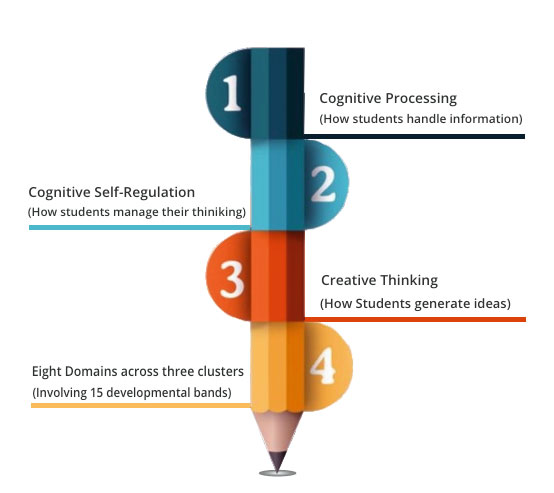
The Cognitive Assessment moves beyond outdated “learning styles” and self-reported preferences. The assessment captures both intuitive efficiency and deliberate reasoning—measuring how students retrieve, process, reflect, and apply information. This provides a fuller understanding of learner capability, well beyond traditional reasoning only tests. It measures actual cognitive processes using validated, research-based methods—helping schools understand how students think, learn, and apply knowledge.
Built Around How Students Think Wadmore Cognitive Assessment is:
Adaptive, Not Fixed
One assessment adapts to every learner— no rigid grade boundaries. It identifies both advanced capability and support needs in real time, capturing true potential across the spectrum.
Strength-Based, Not Deficit-Led
Insights focus on what students can do—and what comes next. No labels, only growth pathways, aligned with holistic development principles.
Culturally Fair by Design
By measuring thinking processes rather than content recall, Wadmore reduces language and curriculum bias— ensuring a more equitable and accurate understanding of ability.

Beyond Learning Styles.
Precision You Can Trust.
Wadmore Cognitive Assessment moves beyond outdated “learning styles” and self-reported preferences to measure actual cognitive processes using validated, research-based methods. Built on IRT/Rasch psychometrics—a globally recognised scientific framework—it places student ability and question difficulty on the same scale, ensuring highly accurate, reliable, and meaningful insights. This enables schools to truly understand how students think, learn, and apply knowledge, delivering far more precise and actionable outcomes than traditional scoring methods.
Cognitive Assessment in the Age of AI
As AI becomes embedded in education, a critical question emerges: are students' cognitive capabilities being developed—or outsourced? Research suggests that over-reliance on AI for reasoning, problem-solving, and planning can limit the effort required to build these essential skills.
Wadmore Cognitive Assessment provides schools with clear, longitudinal visibility into cognitive performance—tracking whether capabilities such as reasoning, executive functioning, and metacognition are growing, stagnating, or declining. This enables evidence-based decisions on how technology should support learning—without replacing the cognitive effort it requires.

