

PEAR Academy's Cognitive Assessment is aligned with National Education Policy 2020 and the Holistic Progress Card (HPC), supporting the shift from marks-based evaluation to competency-driven, holistic development. It measures how students think, reason, and apply knowledge across a developmental continuum, capturing cognitive skills such as problem-solving, memory, and analytical reasoning to provide a more accurate, equitable, and future-ready view of learner capability.
For Teachers:
The platform delivers actionable insights that enable teachers to implement targeted, differentiated instruction and support structured HPC reporting with clear evidence of growth.
For students:
It promotes a strength-based approach by identifying learning readiness and next-step pathways, while building higher-order thinking skills essential for academic success and real-world application.
How a Wadmore Profile Helps For Families
- Support at Home: Provides research-based strategies matched to your child’s cognitive profile.
- Guide Enrichment: Helps select tutoring, activities, and extracurricular programs suited to strengths and growth areas.
- Inform School Discussions: Supports productive conversations with teachers using shared evidence and learning language.
- Understand Daily Learning Patterns: Explains why some tasks feel easy while others are challenging.
- Build on Strengths: Encourages confidence by focusing on strengths while improving growth areas.
- Understand Sibling Differences: Helps parents recognise each child’s unique learning needs without comparison.
- Track Growth Over Time: Enables annual reassessment to monitor progress and adjust support strategies.

Complementary Role Alongside Academic Assessment
Wadmore is not a replacement for academic assessment. It is a distinct and complementary layer of evidence. Academic assessments generally measure what students know and can do within subject domains. Wadmore measures the cognitive capabilities that underpin performance across all subjects.
Together, they answer different questions:
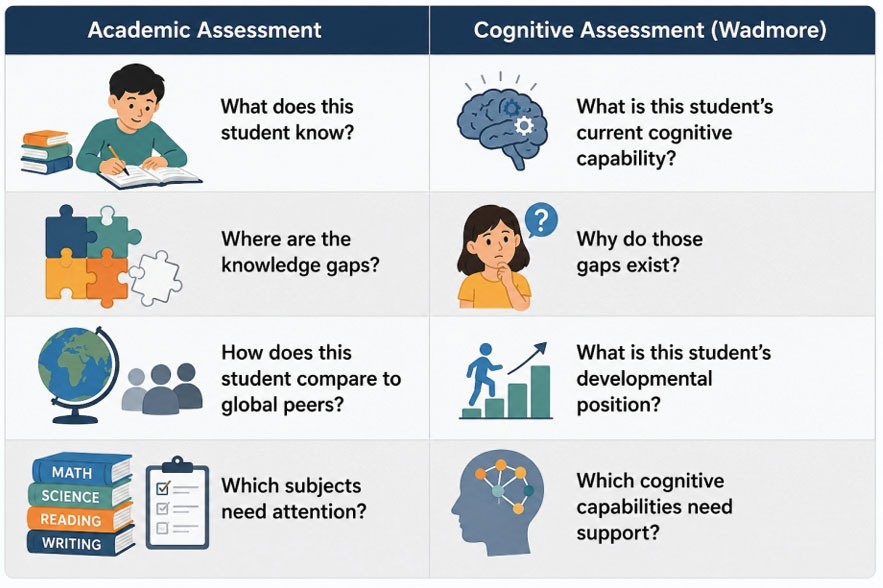
A student who scores well in a Mathematics assessment but shows a low band in Executive Functioning may be relying on strong content knowledge without the planning and self-regulation skills needed for more complex problem-solving in later years. Conversely, a student with high Abstract Reasoning but low Mathematics performance may possess strong cognitive capability that is not being expressed academically - a pattern that is invisible without cognitive profiling.
How School use Wadmore Evidence
Add symbols and very light background shade colour to each.
Differentiated Instruction
Understand the cognitive landscape of your classroom. Evidence about thinking patterns to inform your differentiation decisions.
Learning Support & Intervention
Move beyond observable behaviours to understand cognitive patterns relevant to learning challenges. Evidence to inform intervention planning.
Gifted & Talented
Identify cognitive strengths across all eight domains. Evidence to support decisions about extension and enrichment.
NCCD Evidence
Generate comprehensive cognitive profiles that provide documented evidence for NCCD submissions, including Executive Functioning and Memory data.
Career & Pathways
Help students understand their cognitive patterns to inform pathway conversations. Evidence for discussions, not predictions.
Parent Conversations
Transform parent-teacher meetings with objective, strength-based cognitive evidence. A shared language for discussing growth.
Cognitive Intelligence for Schools – Preview
Get an inside look at our innovative approach to assessing and developing cognitive skills in students. This document outlines our methodology, benefits, and implementation model for schools.
Click here to view the full document
